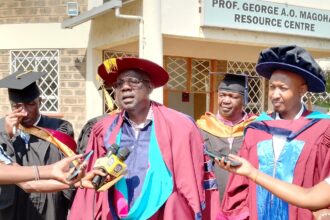
Gates Africa Education Group (GATES) has signed a groundbreaking Memorandum of Understanding (MoU) with the Management University of Africa (MUA), signaling a commitment to transform Kenya’s education system by embracing diagnostic learning and advanced technology.

Speaking at the launch in Nyamasaria, Kisumu, on November 30, GATES Head of Missions Prof. Humphrey Oborah emphasized the need for Kenya to break free from outdated educational paradigms. “Our mission is to ensure Kenya doesn’t keep singing the same song it has for the last 60 years,” he declared. “Learning should be based on diagnostics, and anthropo-biometric technology is the way forward. To compete globally, we must embrace this technology and move away from obsolete systems like CBC and superficial youth funds that offer no sustainable solutions for future generations.”
Prof. Washington Okeyo, MUA Deputy Vice-Chancellor, echoed Oborah’s sentiments, emphasizing the importance of aligning education with technological advancements to equip young people with practical skills for the modern world.
Renowned scholar and keynote speaker Prof. PLO Lumumba praised the collaboration, describing it as a necessary step in ensuring Africa’s youth have access to transformative tools and opportunities.
“Collaboration is key,” Lumumba stated. “In Kiswahili, we say kidole kimoja hakivunji chawa—one finger cannot crush a louse. Africa has lagged behind because it has not fully embraced technology. While the world has moved into nanotechnology, Africa is still trapped in the agrarian age. If we are to compete globally, we must revolutionize our thinking and actions.”

Lumumba lauded Oborah and Okeyo for their relentless efforts to bring stakeholders together for this mission. “The journey you’ve started is monumental. This partnership will combine the best of what GATES, MUA, and other collaborators bring to the table. It is through such synergies that we can reshape the education system to focus on talent, innovation, and practical solutions,” he remarked.
He highlighted Africa’s untapped potential, pointing out the billions of dollars spent annually on importing products and services that could be locally produced. “Africans spend $34 billion importing fake human hair, $12 billion on fake nails, and $10 billion on fake eyelashes. Why can’t these be made in Kenya? Why are we importing fish from China when Kisumu is known for its fish? This collaboration is a reminder that our words must match our actions.”

Oborah also addressed the overemphasis on paper qualifications, calling for a shift towards talent-based education. “Beyond lamentations, we are doing something about it. This partnership is a practical step towards a better future,” he concluded.
The event featured exhibitions by young talents, inspiring attendees to envision a future where Kenya leads in technology-driven education and innovation. As Lumumba aptly summarized, “Competition is the law of the jungle, but cooperation is the law of civilization. This partnership exemplifies the latter and marks the beginning of a brighter chapter for education in Africa.”